
NASA’s solar-powered Juno spacecraft lifted off from Cape Canaveral Air Force Station at 12:25 p.m. EDT Friday to begin a five-year journey to Jupiter.
Juno’s detailed study of the largest planet in our solar system will help reveal Jupiter’s origin and evolution. As the archetype of giant gas planets, Jupiter can help scientists understand the origin of our solar system and learn more about planetary systems around other stars.
“Today, with the launch of the Juno spacecraft, NASA began a journey to yet another new frontier,” NASA Administrator Charles Bolden said. “The future of exploration includes cutting-edge science like this to help us better understand our solar system and an ever-increasing array of challenging destinations.”
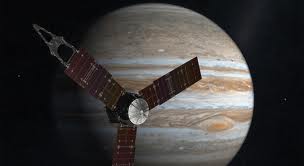
After Juno’s launch aboard an Atlas V rocket, mission controllers now await telemetry from the spacecraft indicating it has achieved its proper orientation, and that its massive solar arrays, the biggest on any NASA deep-space probe, have deployed and are generating power.
“We are on our way, and early indications show we are on our planned trajectory,” said Jan Chodas, Juno project manager at NASA’s Jet Propulsion Laboratory (JPL) in Pasadena, Calif. “We will know more about Juno’s status shortly after its radios are energized and the signal is acquired by the Deep Space Network antennas at Canberra.”
Juno will cover the distance from Earth to the Moon (about 250,000 miles) in less than one day’s time. It will take another five years and 1,740 million miles to complete the journey to Jupiter. The spacecraft will orbit the planet’s poles 33 times and use its collection of eight science instruments to probe beneath the gas giant’s obscuring cloud cover to learn more about its origins, structure, atmosphere, and magnetosphere, and look for a potential solid planetary core.
With four large moons and many smaller moons, Jupiter forms its own miniature solar system. Its composition resembles a star’s, and if it had been about 80 times more massive, the planet could have become a star instead.
Please join the AccuWeather.com Astronomy fanpage by clicking here. You can leave your comments there, as well, and be part of a community where discussions on this or any other astronomy subject take place. We are now well over 1,700 likes on Facebook and recently the growth has been rapid. With your help we will get to 2,000 soon. Tell your friends about this site and blog and weigh in on some exciting issues. We encourage open discussion and will never criticize any idea, and no negative conversation will be allowed.